Evermore Social Development Coaching
Meaningful growth, lasting connection
Evermore is a coaching space focused on social development, confidence, communication, and relationship-building for teens and young adults.
1:1 Coaching
Personalized support focused on social confidence, communication, boundaries, and relationship-building.
Group Programs
Interactive experiences helping teens and young adults develop real-world social skills.
Family Support
Guidance for families to help support growth and confidence at home.
Meet the Founder
Founder Asia-Lee
Helping teens and young adults build confidence, connection, and real‑world social skills.
Mission: To give young people practical tools and supportive coaching so they can navigate friendships, communication, and relationships with confidence—especially those who are neurodivergent or feel socially overwhelmed.
Asia-Lee Saunders is the founder of Evermore Social Development Coaching. As someone who is neurodivergent herself, she understands firsthand how challenging social expectations and communication can sometimes feel. She holds a Master’s degree in School Counseling and has worked with children, teens, and families in roles including care coordination, case management, advocacy, and education.Evermore was created after years of seeing how many young people struggle with friendships, communication, and confidence without clear guidance on how to navigate these experiences. Through Evermore, Asia provides practical social tools, supportive coaching, and a space where teens and young adults—particularly neurodivergent individuals who may experience social situations differently—can develop confidence and build healthier connections.Let’s Work Together
Contact Evermore
Email
support@evermoreconnect.com
Phone
724-201-2039
Why Evermore
Built for connection, confidence, and growth.
Evermore was created to address a gap many teens and young adults experience: they are expected to navigate friendships, communication, dating, boundaries, and social dynamics without ever being directly taught how. While academic support is common, guidance for real‑world social situations is often missing.
Evermore focuses on building the practical skills behind healthy relationships—things like reading social cues, communicating clearly, managing conflict, building confidence, and understanding boundaries. The goal is not to change who someone is, but to give them tools that make social environments easier to navigate.
The program is especially welcoming to neurodivergent individuals who may experience social expectations differently. Through supportive coaching, structured guidance, and real‑life scenario practice, Evermore helps young people develop confidence, connection, and stronger interpersonal skills that carry into school, friendships, work, and adult life.
-
-
-
-
I
The Evermore Method
Story‑based social learning
The Evermore Method uses storytelling and guided reflection to teach real‑world social skills. Instead of only discussing communication and relationships in theory, clients explore symbolic stories that mirror everyday social dynamics. These stories allow teens and young adults to step outside their own experiences and observe behavior, communication patterns, and misunderstandings from a safe distance.
Through discussion, role‑play, and reflection, participants begin to recognize common social patterns—over‑explaining, assuming judgment, misreading intentions, or feeling pressure to defend themselves. By observing these dynamics in story form first, clients can more easily identify them in real‑life situations and practice calmer, more confident responses.
“The Widow Story”
One of the storytelling frameworks used in Evermore is the light-hearted “Widow” narrative. In the story, a mysterious widow finds herself explaining the unusual circumstances surrounding her husband's death. The premise is intentionally dramatic—the widow is theatrical, overly prepared, and deeply worried about how she might be perceived.
As the story unfolds, the widow reflects on conversations, moments, and decisions that led up to the event. Along the way she shares small “pearls” of insight about communication, assumptions, boundaries, and how easily people can misinterpret one another’s intentions.
In the Evermore method, the widow is not someone to imitate. Instead, she acts as a guide showing what can happen when anxiety and overthinking take over a social situation. She clutches her pearls tightly, rehearsing explanations and imagining judgment from others. The exaggeration is intentional—it helps clients recognize similar patterns in everyday life when we over-prepare, over-explain, or feel like we must defend ourselves.
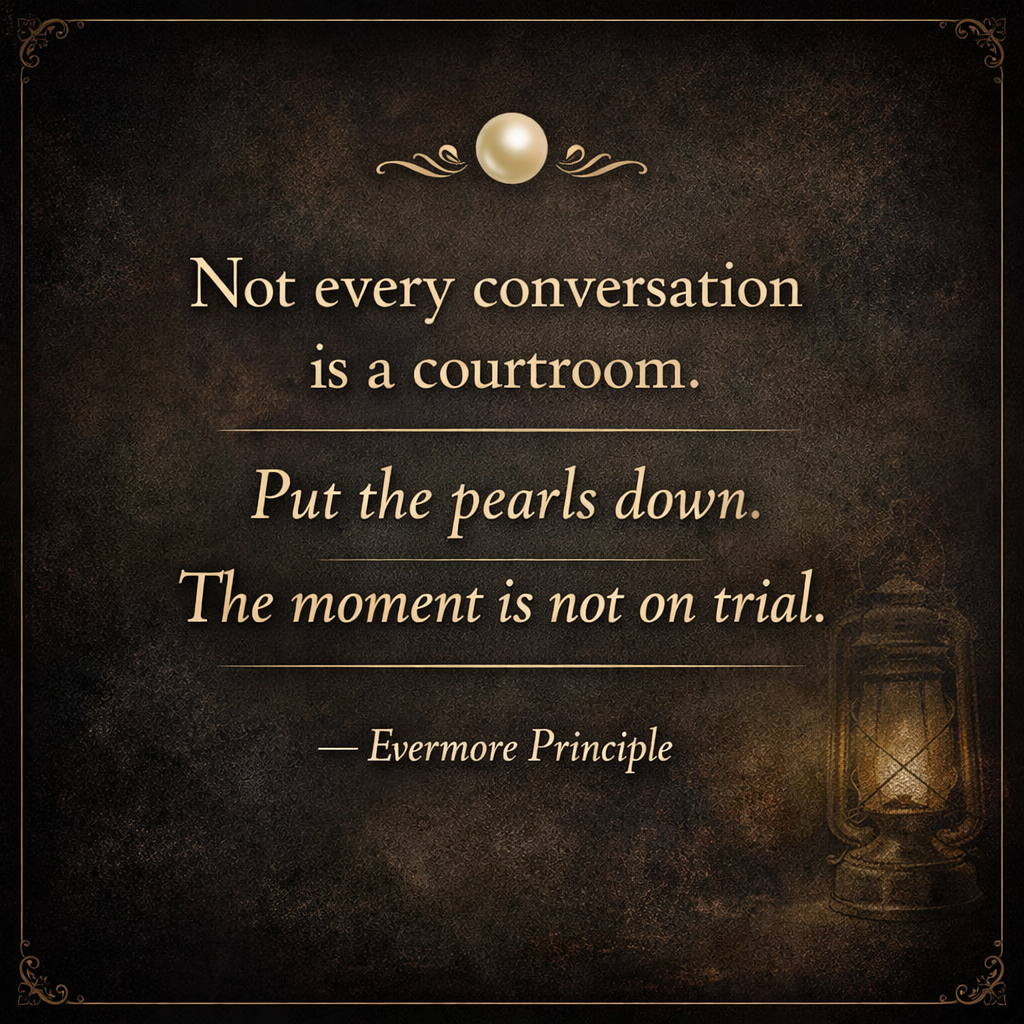
But an important realization emerges as the story develops: there is no real courtroom. There is no jury waiting to judge her and no verdict being delivered. Much of the pressure the widow feels exists only in her own mind. The lesson becomes simple—sometimes we are holding on too tightly to the fear of being misunderstood.
The invitation in Evermore is to “put the pearls down.” To step out of defensiveness, release the need to explain every detail, and respond with calm clarity instead.
A central reflection used in sessions is the question:
“What would the widow do?”
Usually, the answer reveals an anxious or overly complicated response. The Evermore principle then flips the script: say less, simplify the moment, and move forward with confidence rather than performance.
© 2026 Evermore. All rights reserved. support@evermoreconnect.com 724-201-203